

A support agent working a Salesforce case confirms it's a software bug. The fix has to happen in engineering — and engineering works in Jira, not Salesforce. Right now, that handoff is a human copying fields from a Salesforce case into a new Jira issue: summary, description, repro steps, priority, environment, attachments. Then pasting the issue key back into the case. Then babysitting both records for every comment, status transition, and resolution until the fix ships.
A support agent working a ServiceNow incident confirms it's a software defect. The fix has to happen in engineering — and engineering works in GitHub, not ServiceNow. Right now, that handoff is a human copying fields from a ServiceNow incident into a new GitHub issue: title, description, repro steps, severity, environment, screenshots. Then pasting the issue URL back into the incident. Then babysitting both records for every comment, label change, and resolution until the fix ships.
Topics: ServiceNow- GitHub
Read MoreA support agent working a Salesforce case confirms it's a software bug. Engineering needs to fix it — but engineering works in Azure DevOps, not Salesforce. Right now, someone copies the case details into a new Azure DevOps work item: title, description, repro steps, priority, attachments. Then they paste the work item link back into the Salesforce case. Then they spend the next week manually relaying comments, status changes, and resolution between two systems that were never designed to share a record.
Topics: Azure DevOps- Salesforce- Integration
Read MoreA support agent working a ServiceNow incident confirms it's a software defect. The fix has to happen in engineering — and engineering works in Azure DevOps, not ServiceNow. Right now, that handoff is a human copying fields from an incident into a new Azure DevOps work item: title, description, repro steps, severity, environment, attachments. Then pasting the work item URL back into the incident. Then babysitting both records until the fix ships.
Topics: ServiceNow- Azure DevOps- Integration
Read MoreA support agent in ServiceNow takes a P2 incident. They triage it, realize it's a software bug, and now they need engineering to fix it. Engineering lives in Jira.

Topics: ServiceNow- Jira
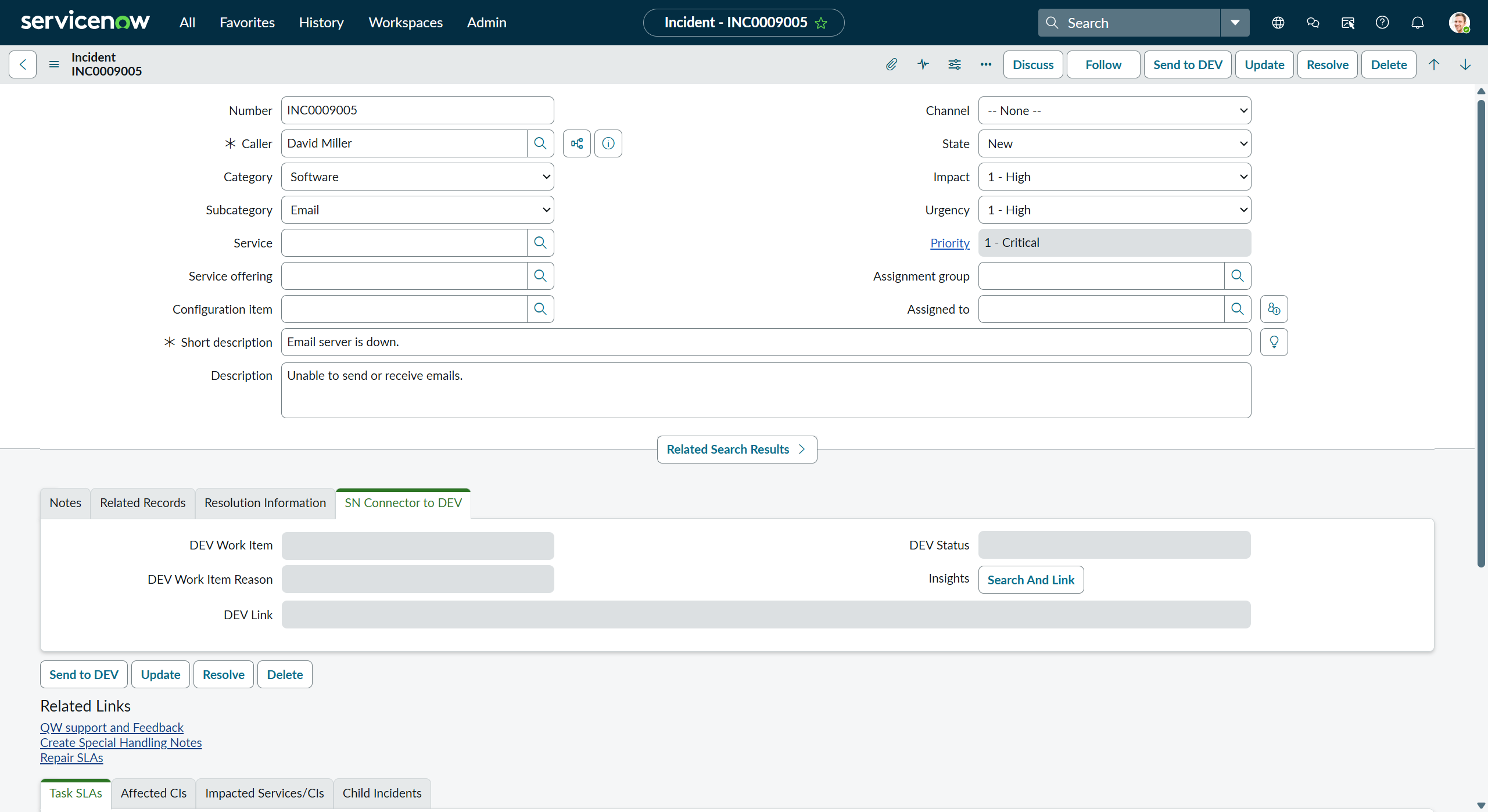
Read MoreServiceNow is the gold standard for IT Service Management (ITSM), offering robust capabilities for incident, problem, change, and request management, while Jira dominates Agile project management and software development with powerful issue tracking, sprint planning, and release management features. In most large organizations, IT operations run on ServiceNow while engineering and product teams live in Jira. Without proper integration, this creates silos, duplicate work, and gaps in communication. Enterprises increasingly need these platforms to work together seamlessly so that incidents, changes, and development tasks stay aligned across the entire lifecycle—from detection and triage to fix, test, and deployment. When ServiceNow and Jira are tightly connected, work flows smoothly between IT and development, teams stay in sync, and leadership gains a clear end-to-end view of what’s happening. Here’s why ServiceNow Jira integration is a game-changer.
Topics: ServiceNow- Jira- Integretion
Read MoreWhen a customer hits a bug, the incident lands in ServiceNow — but the fix lives in Azure DevOps. Most enterprises still bridge that gap by hand: an agent copies the incident into a work item, emails a developer, and then spends the next week chasing status. Integrating ServiceNow with Azure DevOps removes that manual handoff entirely, so support and engineering work off the same source of truth without living in each other's tools.
The benefits of integrating ServiceNow and Azure DevOps compound quickly once escalations, status, and comments flow automatically. Here are the ten that matter most to support and engineering leaders — and why they show up on the bottom line.
The single biggest win: a support agent escalates a confirmed bug or feature request to engineering without leaving ServiceNow, and a linked Azure DevOps work item is created automatically with the incident's context intact. No more "I emailed a developer and I'm waiting to hear back." The handoff becomes a system event, not a favor.
With real-time, bidirectional sync, the work item's state — active, in a sprint, resolved — is visible on the ServiceNow incident. Agents stop interrupting developers with "any update on this?" and developers stop getting pulled out of focus time to answer. The status is just there.
Without visibility into what's already been escalated, three agents will file the same bug three times. A search-before-create step lets an agent find and link an existing work item instead of creating a new one — so engineering triages each defect once, not three times.
A large share of SLA misses aren't caused by slow engineering — they're caused by stale information. Support reports "in progress" on a bug engineering closed two days ago, or promises a fix that isn't real. When status syncs automatically, the incident reflects reality, and the breaches that come from lost-in-translation updates disappear.
Adoption dies when you ask developers to work in a second tool. Integration means engineers get the full incident context on the Azure DevOps work item — description, priority, attachments, custom fields — and work it exactly how they normally do in Azure Boards. Zero context-switching, zero new tool to adopt.
Not every engineering comment should reach the customer. A good integration lets a developer's Azure DevOps comment land in ServiceNow as an internal Work Note rather than a customer-facing update — so teams collaborate candidly without worrying about what leaks into the customer's view.
Every manual step — creating the work item, re-typing comments, reconciling status — adds latency to the incident lifecycle. Automating the relay compresses that lifecycle. Teams routinely take per-escalation handling from minutes of manual data entry down to seconds, and the removed status lag shortens the whole path from report to resolved.
Every incident is linked to its work item and vice versa, with a complete history from report through fix to close. For teams under change-management or compliance requirements, that end-to-end traceability — which code change resolved which customer incident — is difficult to reconstruct manually and trivial when the two systems are connected.
The copy-paste relay is a hidden tax that scales with volume. A team escalating a couple hundred incidents a month can spend the equivalent of a full role's time just moving information between systems. Automating it hands that capacity back to both support and engineering — no hiring required.
Everything above rolls up to the customer experience: faster resolution, accurate status, fewer dropped threads. Customers experience the gap between your systems as your company being disorganized — and they experience a tight integration as competence. That shows up in CSAT scores and, ultimately, in renewals.
The benefits are real, but leadership wants the math. Take a support team escalating ~150 incidents a month to engineering at ~15 minutes of combined agent and developer relay time each — that's roughly 37 hours a month of pure toil, before SLA penalties and churn risk. That's the number to put in front of a budget owner. Run your own with the integration ROI calculator.
Quantum Whisper's packaged ServiceNow Azure DevOps connector delivers these benefits with event-driven, no-code, bidirectional sync — most teams live in about 60 minutes, across Azure DevOps cloud or on-premise, and it's available on Microsoft AppSource. If you want the mechanics, see how to escalate ServiceNow incidents to Azure DevOps.
Why should enterprises integrate ServiceNow with Azure DevOps? Because the customer incident lives in ServiceNow while the fix lives in Azure DevOps, and bridging that gap by hand is slow and error-prone. Integrating the two automates the escalation and keeps status, comments, and resolution in sync, which reduces SLA breaches, speeds resolution, and improves customer satisfaction.
What are the main benefits of a ServiceNow–Azure DevOps integration? Automatic escalation of incidents to engineering, real-time visibility of work item status inside ServiceNow, fewer duplicate work items, lower MTTR, controlled internal-vs-customer comment visibility, a complete audit trail, and recovered team capacity.
Is integrating ServiceNow and Azure DevOps worth it? For teams escalating more than a handful of incidents a week, yes — the recovered relay time alone typically justifies it, before counting the SLA and retention benefits. A quick way to check is to multiply your monthly escalations by the minutes spent manually relaying each one.
Do we have to replace ServiceNow or Azure DevOps? No. The point of integration is that support keeps working in ServiceNow and engineering keeps working in Azure DevOps — neither team changes tools; the data moves between them automatically.
While there are obviously many reasons to integrate, from our experience, customers love our ServiceNow and Azure DevOps integration for it's simplicity, targeted and use cases specific integration, and it's fast and easy set-up and configuration. Customers are always amazed they can be fully integrated within 60 minutes. Remember that each organization’s context may vary, but these reasons highlight the value of integrating ServiceNow and Azure DevOps for enterprises! 🚀
Topics: ServiceNow- Azure DevOps
Read MoreTopics: Jira- Salesforce- Integration
Read More